Hi,
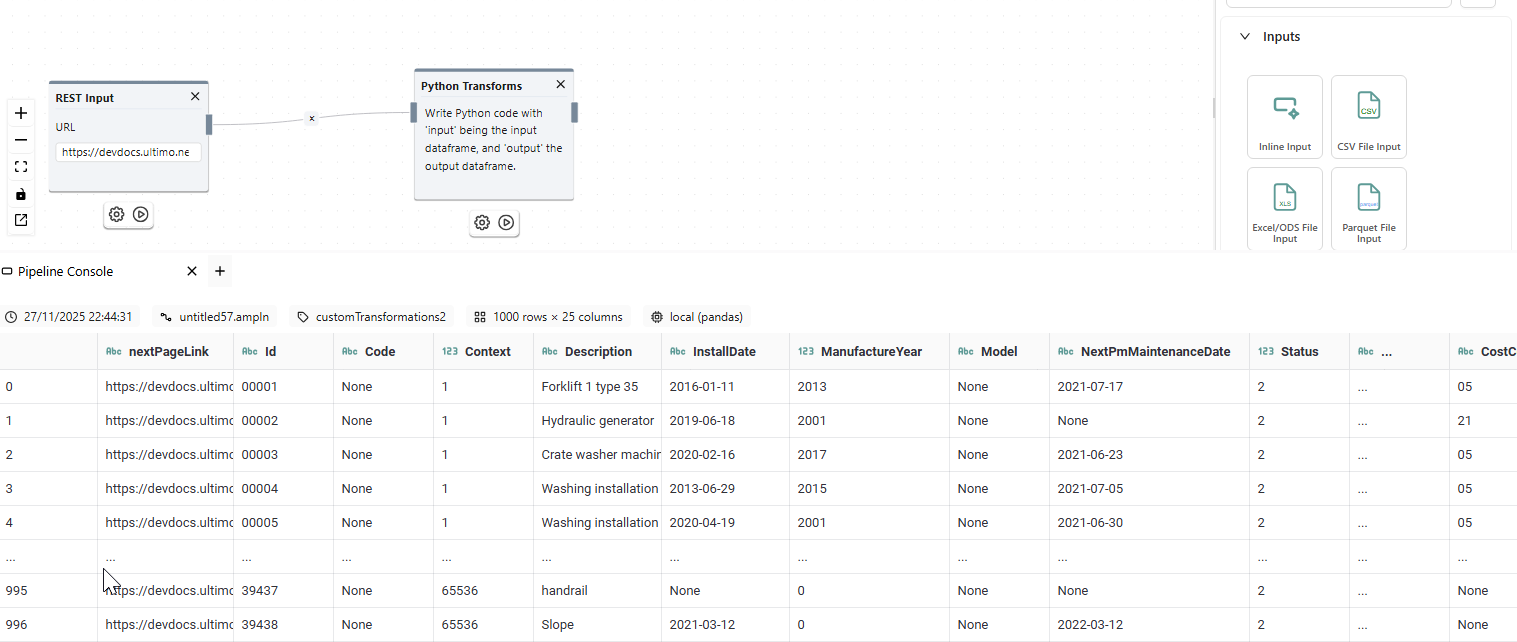
i’m getting json output out of a GET request. Maybe i’m missing something but it is unable for me to explode the arrays into rows.
Can someone help me?

Thanks!
Hi,
i’m getting json output out of a GET request. Maybe i’m missing something but it is unable for me to explode the arrays into rows.
Can someone help me?
Thanks!
Hello @harmenkuijer
Can you please share
-the version of Amphi you’re using ?
-the json (of an example of it) you’re trying to explode in plain text (so that we can have a look to reproduce) ?
Best regards,
Simon
Hi Simon,
thanks for your reply. I’m using the latest version of Amphi. Here you wil find an example output:
{
    "items": [
        {
            "Id": "000811",
            "Code": null,
            "Context": 65536,
            "CurrentMaintenanceStateDate": null,
            "DataProvider": null,
            "Description": "*******************",
            "ExternalId": "E000811",
            "GeocodeX": 0.0000000000,
            "GeocodeY": 0.0000000000,
            "InstallDate": null,
            "ManufactureYear": 0,
            "Status": 2,
            "RiskScore": 0.00,
            "Text1": "*******************",
            "CostCenter": null,
            "CurrentMaintenanceState": null,
            "EquipmentType": null,
            "Manufacturer": null,
            "MaintenanceState": null,
            "PartOfEquipment": null,
            "ProcessFunction": "000241",
            "ProgressStatus": null,
            "Site": "D",
            "Vendor": null
        },
        {
            "Id": "000812",
            "Code": null,
            "Context": 32768,
            "CurrentMaintenanceStateDate": null,
            "DataProvider": null,
            "Description": "*******************",
            "ExternalId": "E000812",
            "GeocodeX": 0.0000000000,
            "GeocodeY": 0.0000000000,
            "InstallDate": null,
            "ManufactureYear": 0,
            "Status": 2,
            "RiskScore": 0.00,
            "Text1": '*******************',
            "CostCenter": null,
            "CurrentMaintenanceState": null,
            "EquipmentType": "00703",
            "Manufacturer": null,
            "MaintenanceState": null,
            "PartOfEquipment": "000811",
            "ProcessFunction": "000241",
            "ProgressStatus": "USEQM0203",
            "Site": "D",
            "Vendor": null
        },
        {
            "Id": "000813",
            "Code": null,
            "Context": 32768,
            "CurrentMaintenanceStateDate": null,
            "DataProvider": null,
            "Description": "",
            "ExternalId": "E000813",
            "GeocodeX": 0.0000000000,
            "GeocodeY": 0.0000000000,
            "InstallDate": null,
            "ManufactureYear": 0,
            "Status": 2,
            "RiskScore": 0.00,
            "Text1": '*******************',
            "CostCenter": null,
            "CurrentMaintenanceState": null,
            "EquipmentType": "00703",
            "Manufacturer": null,
            "MaintenanceState": null,
            "PartOfEquipment": "000811",
            "ProcessFunction": "000241",
            "ProgressStatus": "USEQM0203",
            "Site": "D",
            "Vendor": null
        }
    ]
}
Hello @harmenkuijer
Have you noticed there is single quote around Text1 value1 (instead of quotes)?
But even with that typo solved, yes, there is an issue
For furrther reference https://devdocs.ultimo.net/api/v1/object/Equipment?ApiKey=BED9194293084F68807042B9451B36D0
Can you try this in a python transform?
def flatten_json_column(
df: pd.DataFrame,
json_col: str,
max_level=None,
sep=“.”,
keep_columns=True,
flatten_array_direction=“row”, # “row” (default) or “column”
):
“”"
Flatten a column containing JSON objects or strings into a DataFrame.
Handles nested dicts and arrays, producing either multiple rows or columns.
“”"
def _flatten(obj, parent_key="", level=1):
    """Recursively flatten dicts and lists."""
    items = []

    if isinstance(obj, dict):
        for k, v in obj.items():
            new_key = f"{parent_key}{sep}{k}" if parent_key and keep_columns else k
            if isinstance(v, dict) and (max_level is None or level < max_level):
                items.extend(_flatten(v, new_key, level + 1))
            elif isinstance(v, list) and (max_level is None or level < max_level):
                if flatten_array_direction == "column":
                    # Expand list into numbered columns
                    for i, elem in enumerate(v):
                        if isinstance(elem, (dict, list)):
                            items.extend(_flatten(elem, f"{new_key}{sep}{i}", level + 1))
                        else:
                            items.append((f"{new_key}{sep}{i}", elem))
                else:
                    # Row direction: expand into multiple rows (later)
                    items.append((new_key, v))
            else:
                items.append((new_key, v))
    else:
        # Not a dict: just return the object as value
        items.append((parent_key, obj))
    return items

def _expand_rows(base_row):
    """Handle array-to-row expansion for row mode."""
    array_keys = [k for k, v in base_row.items() if isinstance(v, list)]
    if not array_keys:
        return [base_row]

    # Create Cartesian product of all array elements
    array_values = [base_row[k] for k in array_keys]
    combinations = product(*array_values)

    expanded = []
    for combo in combinations:
        new_row = base_row.copy()
        for k, val in zip(array_keys, combo):
            if isinstance(val, dict):
                for sub_k, sub_v in _flatten(val, k):
                    new_row[sub_k] = sub_v
            else:
                new_row[k] = val
        # Remove list-type columns after expansion
        for k in array_keys:
            if isinstance(new_row.get(k), list):
                del new_row[k]
        expanded.append(new_row)
    return expanded

all_rows = []

for _, row in df.iterrows():
    raw = row[json_col]
    if isinstance(raw, str):
        try:
            data = json.loads(raw)
        except json.JSONDecodeError:
            continue
    else:
        data = raw

    flat_items = dict(_flatten(data))
    base_rows = [flat_items]

    # Expand arrays into rows if needed
    if flatten_array_direction == "row":
        new_rows = []
        for br in base_rows:
            new_rows.extend(_expand_rows(br))
        base_rows = new_rows

    # Merge with other columns
    for br in base_rows:
        combined = row.drop(labels=[json_col]).to_dict()
        combined.update(br)
        all_rows.append(combined)

return pd.DataFrame(all_rows)
output = flatten_json_column(
df=input,
json_col=“items”,
max_level=None,
sep=“.”,
keep_columns=True,
flatten_array_direction=“row”
)
not perfect (I have object, not string) but should be way better.
Edit: also tried to expand the code with the given ‘before’ and ‘after’ code. But still not working.
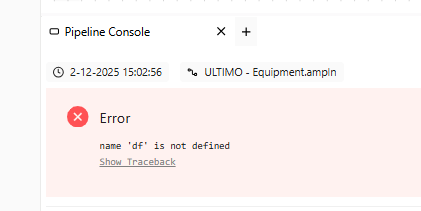
While using only your generated code I get the ‘df is not defined’ error. Can you give me the complete code from your transformer? I think a copy/paste error has occured.
@harmenkuijer Sorry, the copy-pasta killed the code, especially the indentation. I put it on github here but still have some issues on it… 
Used a Python transformer with the following code:
output = input.explode('data').reset_index(drop=True)

output = pd.concat([
    output.drop('data', axis=1),
    output['data'].apply(pd.Series)
], axis=1)

output = output.drop(columns=['data'], errors='ignore')